


AI data centres have been big news in Teesside this week, with plans scrapped, others being floated, and some being approved.
This week’s edition is guest written by Anne Alexander, a journalist who covers the AI industry on her own Substack, The AI Arms Race. She’s also currently working on a project with Watershed Investigations which is creating a dataset of the UK data centre sector and modelling data centre water use on-site and at the power source. And she’s written for our sister national publication too about the state of AI data centres across the country.
Who better to write this edition, given how it seems to have kicked off in Stockton this week over the proposed £10bn scheme.
It’s free to get The Teesside Lead to your inbox every Sunday, but subscribers get a little bit more, and for another 24 hours you can get half price off an annual sub through our Black Friday deal. Thanks to everybody who’s already supporting our independent journalism covering the Tees Valley.
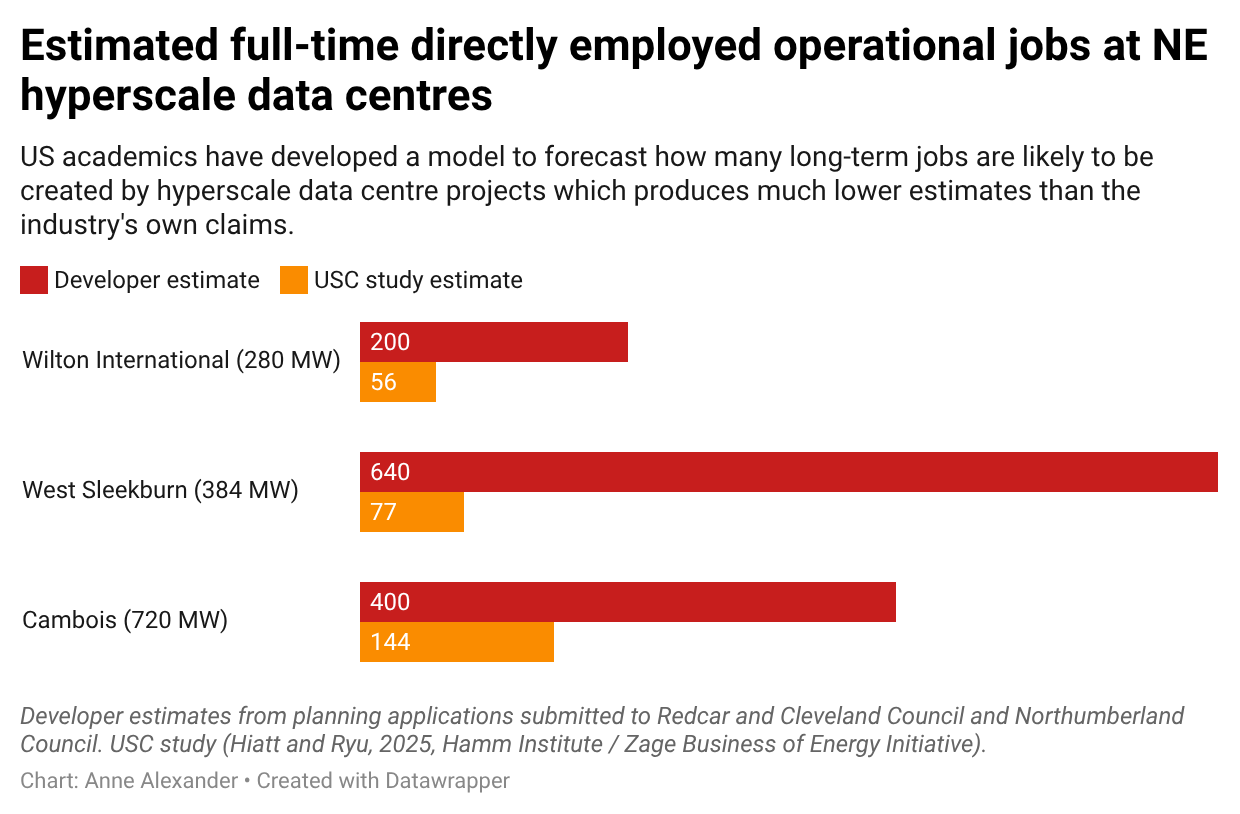
Developers claim their data centres will create hundreds of new permanent jobs at every site. A study by US experts predicts a few dozen.
Hyperscale data centre clusters in the North East are likely to create far fewer operational jobs than claimed by developers, experts from the University of Southern California have told The Teesside Lead.
Professor Shon Hiatt and Dr Angela Ryu from the USC’s Zage Business of Energy Initiative have published a forecast of employment patterns associated with data centre development in the United States which ought to make sobering reading for communities hoping that the energy-hungry campuses will provide significant numbers of long-term jobs for local people.
The number of jobs delivered by data centre schemes is a large part of the argument in favour of them, but the experts’ figures cast doubts on a number of proposed projects in the Tees Valley.
Analysis of employment estimates for three data centres on Teesside and in Blyth by The Lead found Hiatt and Ryu’s model predicted 80 percent fewer jobs than the developers’ claims.
Redcar and Cleveland and Northumberland Councils have seen a spate of major data centre applications recently, with at least 2.8 GW of data capacity now in the planning system or under construction. Digital Reef and Sembcorp are building a 280 MW data centre on land at Wilton International on Teesside which received planning permission on 29 October.
An even larger data centre has been announced by Teesworks which is expected to be served by a 1 GW-capacity electricity substation - supposedly the country’s largest substation - constructed through the government’s “Great Grid Upgrade.”